
Freshwater Aquarium Setup
1. Choosing the Right Aquarium
Although it is important to choose an aquarium that you think will look good in your living room, there are other equally important considerations that affect the ongoing expense as well as the health of the inhabitants!
In general we have found that stability of the environment is the most important secret to successful fish keeping. A lot of material has been written about the ideal environment for various species of fish, whether they like warm water or cold water, high Ph or low Ph, hard water or soft water, but this is generally useful only if you are attempting to breed the fish or are planning on keeping a very sensitive fish that is known to be challenging. In choosing all of the items and the fish themselves, always keep in mind the stability of the environment.
One of the first choices you will face is whether to purchase a glass or acrylic aquarium. The differences are listed in the box below.
| Acrylic Aquarium vs. Glass Aquarium | Acrylic Aquarium |
|---|---|
1. Acrylic is a better insulator than glass so a smaller heater will work for the same sized aquarium and temperature fluctuations happen slower. This is good for stability! 6. Acrylic can be shipped via postal, UPS, or FedEx. Glass aquariums cannot be shipped by these carriers so you must purchase them from a pet store. | 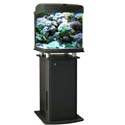 |
| The Nano Cube aquarium exemplifies high-tech performance in a miniature environment. An ideal depth for rock stacking and planting; the design offers seamless panoramic viewing. |
2. Size of the Aquarium
Always choose the largest size that fits your living room and your budget!
Don’t be fooled into thinking that the smaller the aquarium the easier it will be. Actually, the larger the aquarium is the more stable it will be and the easier it will be to maintain healthy fish. The amount of oxygen available (which is critical to fish survival) is determined mainly by the amount of surface area of the aquarium (not just the size) since oxygen enters the water primarily at the surface. Although aeration, with an air stone or a power head, seems like it is directly adding oxygen to the water, most of the benefit comes from moving water from the bottom of the aquarium to the surface where oxygen is exchanged for carbon dioxide.
Water movement at the surface also increases oxygenation and will generally increase the stocking capacity as well as the health of the fish. Keep in mind that airstones and powerheads can (and generally will) fail at some time or another so don’t overstock an aquarium to the point that your fish will die if the power goes out for a couple of hours! It is almost always more desirable to have a few less fish that are colorful and healthy than to push the limits of the tank and risk loosing some of your fish. Not only are fish happier, but the maintenance is easier!
The larger the aquarium, or the fewer the fish, the greater is your chance of having a successful experience!
3. Filters and Filtration
There are three main types of filtration for freshwater aquaria: biological, mechanical, and chemical.
Utilizing each of these three types of filtration will provide you with the most stable and most easily maintained aquarium. General aquarium filters manufactured today include each of these three main types of filtration in some manner.
We will also mention several other methods below, that are more commonly used in reef systems, but that can also be beneficial for fish only systems.
| Marine Aquarium vs. Freshwater Aquarium |
|---|
| 1. Specially formulated salt must be added to the marine aquarium water. For salt we use Coralife or Instant Ocean, but any major brand will work as well. Measured with a hydrometer, specific gravity should be between 1.020 and 1.025. This is about 1/2 cup per gallon. 2. To keep the hardness and calcium at higher levels, crushed coral and/or aragonite should be used in a marine aquarium. Also, the marine aquarium decorations can be coral skeletons, shells, and other calcium containing objects. These types of decorations are to be avoided in most freshwater systems. 3. The number of fish that can be safely kept in a marine aquarium is 1/3 to 1/5 that of freshwater, or about 1 inch of fish for each 5 gallons of aquarium water. |
The three main types of filtration are:
1. Biological Aquarium Filtration:
This is the most important type of filtration for stability and reduction of toxic wastes.
Nitrification: In any biological environment there will be a production of ammonia from normal respiration (fish release ammonia from their gills) and the breakdown of wastes. Ammonia is toxic to fish and in nature is reduced to nitrite by a bacteria called Nitrosonomas. Nitrite is also poisonous to fish and is further broken down into nitrate by bacteria called Nitrobacter. Nitrate is relatively harmless to fish but is a primary food for plants and algae. Frequent water changes (say 10% every week or two) will control nitrate levels. Collectively the process of turning ammonia to nitrate is called nitrification and is carried out in the presence of oxygen (aerobic conditions).
Denitrification: This is the process where nitrates are converted to nitrogen gas in the absence of oxygen (anaerobic conditions). Denitrification is generally not of concern to the freshwater aquarist unless the control of nitrates is desired (See Reef Aquarium Basics).
| Sponge filters work by passing water over a highly porous sponge where bacteria are allowed to grow. They are almost purely biological with some mechanical filtration provided by the sponge itself. The sponge should not be cleaned or allowed to dry out because this will kill the nitrifying bacteria. Sponge filters are good for breeding situations where very small fish are at risk of being sucked up by the strong intake currents of canister filters or overflows. They are also good for fish like bubble-eyed goldfish that may be injured by strong intake currents of power or canister filters. Sponge filters can be powerd by air pumps or small water pumps. | 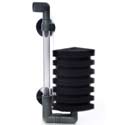 Sponge/Foam Filters |
Undergravel filters are the most common type of biological filter and work by pulling water down through a bed of gravel at the bottom of the aquarium and pulling it up through the uplift tubes. Reverse flow undergravel filters are set up to pull water from the top of the aquarium by pushing it down the uplift tubes and up through the gravel. Reverse flow filters are slightly more efficient since they take water from the top of the aquarium which contains more oxygen.
Since nitrification is more efficient in the presence of oxygen and the air contains about 20% oxygen, as compared to about 7% oxygen for water, trickle or wet/dry filters were developed in the 1980’s which increased the efficiency of biological filters dramatically. They place the bacterial growing medium, filter balls with large surface areas, in the air (usually outside the aquarium) and trickle the water to be filtered over them. Many kinds, sizes, and shapes of trickle filters have been in use since they were introduced. Although many trickle filters are external devices used in a sump or hang on the back type of filters, several manufacturers including the “Sea Clear System II” aquarium contain trickle filters built into the back of the aquarium itself. The problem with trickle filters is they usually produce high levels of nitrate, and so are not often used in reef aquariums or other situations where nitrates are undesireable. Read more about nitrates here.
Canister filters have a containers or baskets inside the filter for various filter media. For biological filtration you would fill it with some sort of biological media, such as bio balls. This media will either come with the filter or can be purchased separately. Once the bacteria colony has been established on this media you will not need to remove it or clean it.
Standard Power filters use disposable cartridges that have a floss pad surrounding them. This pad is primarily for mechanical filtration but will also house nitrifying bacteria. The drawback to this as a primary biological filter is when you dispose of the cartridge, you dispose of the bacteria colony as well.
Advanced power filters include a separate area for biological media. These are usually in the form of a compartment in the filter filled with biological media or an attached external ‘bio wheel’, a pleated wheel that the water flows over as it is leaving the filter and returning to the aquarium.
| Examples of Biological Aquarium Filtration | ||
|---|---|---|
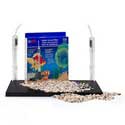 Undergravel Filter – 10 Gallon Undergravel filters use either an airpump or powerheads to pump water from under the gravel through the uplift tubes to the top of the aquarium. | 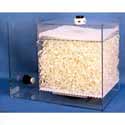 Wet/Dry Filters Models like these use gravity to feed overflow water from the aquarium and return it using a pump or power head. | 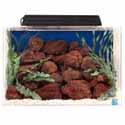 Sea Clear System II Aquarium The System II models have a built-in trickle filter in the back, which provides the biological filtration. |
2. Mechanical Water Filtration:
Mechanical filtration is good for keeping the water clear and free of debris!
Mechanical filtration refers to the removal of particulate matter from the aquarium. Canisters and power filters which force the water through some kind of floss or pleated cartridge are both examples of mechanical filtration. Some canister filters such as the “Hot Magnum” provide one media basket for your choice of mechanical filter media or carbon. Other canister filters have more than one basket for a combination of mechanical, chemical (carbon), and biological filtration. Undergravel filters also act as mechanical filters by trapping debris in the gravel. This is one reason the gravel should be siphoned periodically to remove trapped debris.
Diatomaceous earth filters, commonly available in canister filters, can remove particles as small as 3 microns in size which really ‘polishes’ the water. They can be used to remove bacteria and algae blooms but generally clog after a short period of time and should not be used on a continuous basis.
| Examples of Mechanical Aquarium Filtration | ||
|---|---|---|
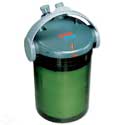 Eheim Multistage Canister Filter Mechanical filters pump the water through a fine material or sponge to remove particles. Several types of canister filters such as the Fluval, which also provide biological and chemical filtration by placing 3 media compartments, one for each of the filtration types. | 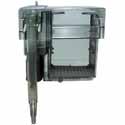 AquaClear Powerfilters 110 (500) Power Filters hang on the back of the aquarium and pump water through filter pads that can also contain carbon for chemical filtration as well. | 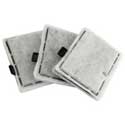 Power Filter Cartridges Power filters require the right sized cartridges that may contain small amounts of carbon for chemical as well as mechanical filtration. |
3. Chemical Aquarium Filtration
| Chemical filters are most useful in getting rid of the yellow color that often develops in aquarium water over time! Chemical filters are used to remove things that are dissolved in the water, and therefore cannot be removed by mechanical filters. The most common chemical filter is activated carbon, used mostly in canister and power filters, it traps many substances in it’s minute pores. According to Martin Moe in his book, The Marine Aquarium Handbook, some of the substances removed by activated carbon are: copper, ozone, chlorine, antibiotics, some dissolved proteins and carbohydrates, iodine, mercury, cobalt, iron, methylene blue (a common medication), malachite green (another medication), sulfa drugs, organic dyes, and many other elements and compounds. Other chemical media include:
Nitrate and phosphate control is usually not needed in freshwater aquariums unless the levels become very high, or there is a continual problem with undesireable algae blooms. Mini-reef aquariums are the most likely candidates for nitrate and phosphate removers if other means of control don’t work. Note: Many of the common aquarium medications including antibiotics are removed by activated carbon. Therefore activated carbon should not be used when treating the aquarium for disease. | |
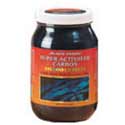 Activated Carbon 1.6L | |
 Ammo-chips 12 oz. | |
 Nitra-zorb 7.4 oz. | |
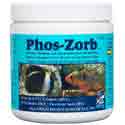 Phos-zorb 7.4 oz. |
Other aquarium filtration methods
| Foam Fractionators, or protein skimmers Protein skimmers work by passing a large stream of small bubbles through a column of aquarium water. Many different substances (proteins) will adhere to the surface of the bubbles and be removed from the water in the foam that bubbles from the top. Skimmers are beneficial because they remove substances before they enter into the nitrification cycle which reduces nitrates and increases oxygenation of the aquarium water. One of the drawbacks to skimmers is that they remove trace elements and iodine which, if needed by any of the aquarium inhabitants, must be replaced periodically. This is not usually an issue in freshwater or saltwater aquariums, but both types can benefit from the use of a protein skimmer. | 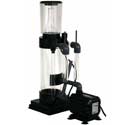 Aqua Medic Protein Skimmer This model is a stand-alone or may be placed in the aquarium sump. |
| Ultraviolet sterilization Ultraviolet sterilization works by passing water through ultraviolet light. If the water is exposed long enough, at a high enough concentration of light, bacteria, algae, and parasites can be destroyed by the light. This is used extensively in ponds to help with algae and green water. Treatment of diseases in aquariums requires the most amount of exposure. The smallest units ( 8-9 watt) are made for tanks up to 50 gallons, while the larger 40 watt units are made for tanks up to 180 gallons. For pond applications, 8 watts per 1000 gallons is needed to kill off algae (green water) but is not effective for disease control. | 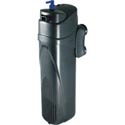 This is a Submariner in-tank model made for an aquarium application. The bulbs should be replaced about every 4-6 months. |
| Ozone Ozone can be passed through aquarium water to oxidize all forms of organic pollutants and kill many of the same organisms that ultraviolet radiation does. Commonly used in skimmers, one should make certain the materials used are “ozone safe” and that the water is passed through activated carbon before returning it to the aquarium because any residual ozone in the water is extremely toxic to the fish. Ozone is useful mainly in large public aquariums and ponds to keep the water from coloring. | 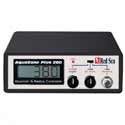 Red Sea Aquazone Ozonizer |
Choosing the Inhabitants
1. Stocking Capacity of a Freshwater System
The first thing you probably want to know is how many fish you can keep in a particular sized aquarium.
The two most common formulas for the amount of fish you can safely keep are:
Simple method: Keep one inch (1″) of fish for each one (1) gallon of water.
This simple method doesn’t take into account the surface area of the water (for oxygenation), the filtration system (for removal of wastes), and the general size of the fish. For instance, a fish that is 6 inches long needs a lot more oxygen than 6 fish that are 1 inch long. In general you should reduce the amount of fish if they are larger, and increase the amount of fish if they are smaller.
Surface method: Calculate the surface area of the aquarium.
Multiply the length of the aquarium times the width of the aquarium (in inches) and divide by 12 to get the number of inches of fish the aquarium can handle.
This surface method takes into account the aquarium shape but not the filtration or the size of the fish. The second formula favors aquariums that are shorter and wider i.e. not ‘showtanks’ which are taller and skinnier.
- Note: Neither formula is for coldwater aquariums! In coldwater aquariums you should keep about 2 1/2 times LESS fish than in a tropical aquarium. This means that the surface area should be divided by 30 to get the number of COLDWATER fish for a freshwater aquarium.
In general the more complicated formulas are not worth the trouble if you don’t approach the maximum number of fish calculated by the above formulas. Perhaps if anyone shows interest, we can write more on this later.
2. Community Aquarium? or Species Aquarium?
One of the funnest things about setting up an aquarium is choosing the fish!
You should probably have some idea of what type of fish you want to keep before stocking the tank to avoid problems later. Do some research on each fish before adding them to your aquarium.
Some fish are predatory or aggressive and so should be kept either by themselves, or with other predatory species. Aggressive species include Oscars, Jack Dempseys and many cichlids.
Some fish are slow feeders, or are very shy and should be kept by themselves in a species tank. A good example of this is Discus fish.

Maintenance, Care, Feeding
1. Water Quality
By most accounts freshwater systems need partial water changes on a regular basis.
The recommended water change is to change about 15% per month. Note that this is lower than what is usually recommended for saltwater. In deciding how much and how often you wish to do water changes, keep in mind that for stability, smaller water changes done frequently are best. The main reason for water changes is to remove compounds that are not removed by any of the filtration methods such as nitrates and phosphates. Water changes also serve to replenish trace elements, and to clean the gravel of accumulated detritus and waste.
Any activated carbon you are using should be replaced monthly.
- See Fish-Care, Maintenance for more information about freshwater aquarium maintenance.
2. Feeding
Make sure to find out any special feeding requirements your fish may have before purchasing them and be sure you can provide them what they need!
In any case, get your fish to eat as many different kinds of food as you can to ensure they are getting everything they need. Some fish are used to eating all the time so they should be fed as often as is practical (always small amounts at least once per day) while others, like eels can go for several days without food at all. The more you feed your fish the faster they will grow to their maximum sizes.

Quick Guide to Setting Up a Freshwater Aquarium
| Aquarium Set-up Basics |
|---|
1. Obtain as large an aquarium as possible. 2. Purchase the following aquarium set-up components.
3. Set up the aquarium on a sturdy floor in a draft free area
4. Run the aquarium for several hours.
5. Cycle the Aquarium and then add fish
|
Featured Image Credit: Vikram Mudaliar, Unsplash