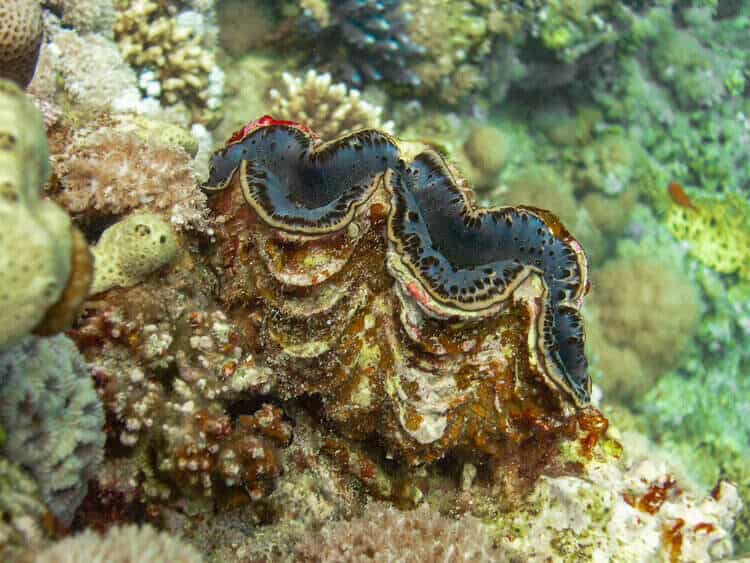
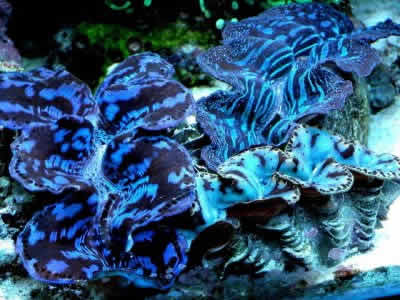
Tridacna clams and Hippopus Clams have become very popular reef aquarium inhabitants. They are very beautiful and if given the right conditions will thrive!
The largest of the giant clams is Tridacna gigas. This particular species of giant clam is also known by the common name “Giant Clam” because of its incredibly large size. This giant clam can reach a length of over 4 feet (120 cm) and may weigh over 500 pounds.
There are five species of giant clams from the Tridacna genus that are commonly offered for sale in the aquarium industry. One of the favorites is the beautiful Maxima, Tridacna maxima clam. Other popular giant Tridacna clams to keep in a reef aquarium are the Crocea Clam Tridacna crocea, Squamosa Clam Tridacna squamosa, and the Derasa Clam Tridacna derasa.
In the Hippopus genus there are two species of giant clam. Of these two species, only one, the Hippopus Clam H. Hippopus is becoming more readily available in the aquarium trade. This clam is not only enjoyed in the hobby, but is prized for its beautiful shell.
Tridacna Clams and Hippopus Clams are beautiful, hardy, grow rapidly, and require little care. But it’s important to be as well prepared as you possibly can for the care of your clam before actually purchasing one, and then how to maintain it over time. With proper clam care, you will also be able to identify clam ailments and problems.
More care information forTridacnid Clams
Marine Aquarium Care:
Giant clams are not only kept in aquariums. The large adductor muscles on these clams are used as a food by native people’s throughout the Indo-Pacific and Red Sea areas, where they are found. The adductor muscles are the large muscles clams use to close their shell. Many of the giant clams are now captive raised at clam farms to supply both the food and aquarium trades.
Some of the latest reef aquarium science can be found in Julian Sprung and J. Charles Delbeeks’ books, The Reef Aquarium – Volume One with a bit more information in Volume Two. They describe seven species in all. These books are some of the best references for keeping Tridacna clams in the aquarium.
- See Caring For Tridacnid Clams to: Obtain a healthy clam, Provide good clam care, Identify clam ailments, and Prevent clam problems.
- See Tridacnid Clams: Friends, Enemies & Ailments to learn about each clam problem and how to solve it.
When adding giant clams to reef aquariums, there are a few special considerations for the reef aquarium setup:
- Reef Aquarium LIghting:The mantle of tridacna clams contain zooxanthellae so they require strong light sources. The clams with blue mantles (crocea, gigas) require more light than those with brown mantles. This is because they occur in shallower water and the blue color of the mantle acts as a light filter. Those with brown mantles are also generally easier to keep. It has also been found that smaller clams require less light than larger ones.
- Reef Supplements / Trace Elements:Clams also require calcium (at least 280 mg/l but preferably up to 480 mg/l), strontium, and iodine for enhanced growth and color.
- Clam Predators:
Some fish, namely wrasses, should be watched when put into a tank containing tridacna clams. The Twin Spot Wrasse (Coris aygula) and the Bird Wrasse (Gomphosus varius) have been known to attack and eat clams. Other predators include large crabs, some shrimp (Marble shrimp; Saron marmoratus, Buffalo shrimp; Saron sp., rarely the Cleaner shrimp, Lysmata amboinensis), and parasitic snails that are usually present on the clam when you buy it.
See Caring For Tridacnid Clams, for more indepth information on keeping all types of clams.
Types of Clams:
Tridacna Clams – The Basics. Tridacna clams taxonomy:
- Phylum: Mollusca
- Class: Bivalvia
- Order: Veneroidea
- Family: Cardiidae
- SubFamily: Tridacninae
The giant clams have long belonged to the family Tridacnidae, but according to the World Registry of Marine Species WORMS (updated August 24, 2009) they are now included in the family Cardiidae as the subfamily Tridacninae. As such,Tridacnidae is no longer being accepted as the family though the genus names are still the same.
The Tridacninae family can be broken down into two genera containing nine species as follows:
- Hippopus (genus)
- Hippopus hippopus – Hippopus Clam, Horse’s Hoof clam .
(H. hippopus also known as Bear Paw Clam and Strawberry Clam) - Hippopus porcellanus – China Clam
- Hippopus hippopus – Hippopus Clam, Horse’s Hoof clam .
- Tridacna (genus)
- Tridacna crocea – Crocea Clam, Crocea
(T. crocea is also known as the Boring Clam, Boring Giant Clam, Crocus Clam, and Saffron-Colored Giant Clam) - Tridacna derasa – Derasa Clam
- Tridacna gigas – Giant Clam
- Tridacna maxima – Maxima Clam, Maxima
- Tridacna squamosa – Squamosa Clam
- Tridacna mbalavuana Ladd – Tevoro Clam
(Syn: Tridacna tevoroa) - Tridacna costata. This species of giant clam is very new discovery. It was first reported and described as a new living species in 2008 by Roa-Quiaoit, Kochzius, Jantzen, Zibdah, and Richter. This giant clam has a small population, is highly endangered, and not found in the aquarium industry.
This species is said to represent less than 1% of the giant clams found in nature. However most of the giant clam shells that have been found, about 80% of them, are of this species. Due to this large number of shells, experts believed that the few number of clams seen today is because it has been heavily harvested by humans for thousands of years. They suggest harvesting these clams goes back to humans occupying the Red Sea area since about 125,000 years ago.
- Tridacna crocea – Crocea Clam, Crocea
A tenth species, Tridacna rosewateri, isn’t being generally accepted because it was described only from shells found in an isolated region in the Indian Ocean.
Where to Find Clams:
Tridacna clams are found throughout the Indo-Pacific and Red Sea areas. Where to find clams in their habitat, they are usually found among corals or on sand and rubble areas next to reefs. The following table shows the giant clams’ distribution areas.
| Type of Clam | Distribution | Notes |
|---|---|---|
| Hippopus hippopus | Found from the Nicobar Islands to Tonga. | |
| Hippopus porcellanus | Found only between eastern Indonesia and western Papua-New Guinea. | |
| Tridacna crocea | Found from the Nicobar Islands in the west to Fiji in the east. | |
| Tridacna derasa | ||
| Tridacna gigas | There are doubts about T. gigas actually being found in Fiji. According to The Reef Aquarium Volume One, years of observations throughout Fiji have never turned up any living T. gigas or fossil shells. T. gigas has, however, been “re-introduced” there. | |
| Tridacna maxima | Found throughout the Indo-Pacific, from the Red Sea in the west to Tonga and Pitcairn Island in the east. | These Tridacna clams have the largest distribution area. |
| Tridacna squamosa | ||
| Tridacna tevoroa | So far has only been found in eastern Fiji and islands within the Ha’apai and Vava’u groups of Tonga. | |
| Tridacna costata | Found in shallow waters of the Red Sea. | This species is said to represent less than 1% of the giant clams found in nature, although about 80% of the giant clam shells found are of this species. Because of this large number of shells, it is believed that it has been heavily harvested by humans occupying the Red Sea area since about 125,000 years ago. |
Tridacna clams are usually limited to shallow water where they’ll receive the most light. Some are found in water shallow enough that the clam is exposed to air during low tide. T. gigas can be found as deep as 66 feet (20 meters). T. tevoroa is only found in deep water.
Research on Clams
Morphology and Clam Anatomy: Research on clams involves not only their morphology (form and structure), but also the clam anatomy and how it functions. Clam shells are only one part of the giant clams makeup. Giant Clams have a number of other anatomical parts which help them feed and maintain metabolism, control light, and attach themselves to the substrate.
- Clam Shells: Tridacna clams have two valves (shells), like normal clams.
- Clam Mantle: The major difference between normal clams and Tridacna clams is the presence of zooxanthellae.The mantle of the clam increases the surface area available for exposure to light. The mantle is an extension of the inhalant and exhalent siphons and is also referred to as siphonal tissue. The mantle contains majority of the zooxanthellae as well as fixed cells called iridophores that contain pigments.
- Pigment Coloration: The mantle pigments are mainly in the color range of blue to brown or green to yellow. These pigments and their combinations are the reason for the wide range of colors and patterns that are found in these clams.
- Pigment Function: The pigments’ main function is to protect the clam against excessive light and UV radiation. If clams do not receive the proper light intensity and quality, they will lose their bright colors. This can happen very quickly. When clams lose their bright colors, the brown color of the zooxanthellae becomes visible. Unless conditions are improved immediately, the zooxanthellae may begin to disappear too, and the clam will take on a whitish-brown color. This condition is called bleaching and once this has occurred, death will follow. Improper lighting does not always cause bleaching. Bleached clams have been reported under intense metal halide lighting. This lighting is normally ideal, but the bleaching may still occur when iodine has been depleted
- Clam Siphons:
- Inhalant Siphon: The inhalant siphon is made up of an elongated opening. Fringing tentacles sometimes surround this opening. The tentacles will strain out large particles.
- Inhalant Siphon: The exhalent siphon forms a raised cone, which can be found further along the mantle from the inhalant siphon. Water leaves the clam’s body cavity through the exhalant siphon after being filtered by the gills.
Another result of the rotation described above is that the muscular foot, which is very prominent in other clams, is greatly reduced in Tridacna clams. The foot of a Tridacna can be found next to the hinge of the valves. - Byssus Gland: To make up for the small and functionless foot. Tridacna clams have a more prominent byssus gland. The byssus gland produces filaments called byssal threads that extend through an opening between the two valves and fasten the clam to the substrate.
- Byssal Threads: The larger clams, T. gigas, T. derasa, T. tevoroa, and Hippopus spp., will lose these glands as they grow. Instead of fastening themselves to the substrate with byssal threads, they will rely on their size and weight to hold them in place.
- Light Control:
- Eyes: Tridacna clams have hundreds of eyes along the edges of their siphonal tissue (mantle). T. crocea and T. maxima can also have eyes on top of raised tubercles scattered over the mantle surface.
– These eyes are used mostly to detect shadows, which warn the clam of potential predators.
– The eyes are also sensitive to green, blue, and ultraviolet light. This helps the clam to position itself toward the light to expose as much zooxanthellae as possible.
– The eyes may also function to detect excessive amounts of potentially harmful UV wavelengths. - Hyaline Organs: Clams also have light concentrating organs in their mantles called hyaline organs. Hyaline organs are translucent windows that allow more light onto pockets of zooxanthellae. This increases the clam’s metabolism
- Eyes: Tridacna clams have hundreds of eyes along the edges of their siphonal tissue (mantle). T. crocea and T. maxima can also have eyes on top of raised tubercles scattered over the mantle surface.
What Do Clams Eat
Nutrition – Feeding: Most clams fulfill their nutritional requirements by, among others, filter feeding and absorbing dissolved organic compounds from the water. Tridacna clams have gone further than this by using zooxanthellae to manufacture food for themselves.
- The role of zooxanthellae:
- How zooxanthellae is introduced:
Clams obtain their zooxanthellae when they are juveniles. The zooxanthellae is introduced through the feeding organs and move from the stomach to the mantle through the tubule system. If the zooxanthellae weren’t resistant to digestion, it would never make it to the mantle. - Where zooxanthellae resides:
The zooxanthellae are located within zooxanthellal tubules. The tubules extend from the stomach into the mantle tissue. This is different from corals who’s zooxanthellae are located within individual cells. The zooxanthellae (through photosynthesis) provide clams with the same products corals receive. - Nutritional Benefits of zooxanthellae:
The zooxanthellae transforms carbon dioxide and dissolved nitrogen, such as ammonium, into carbohydrates and other nutrients for their hosts. Some other nutrients the clams receive from the zooxanthellae are: carbon (in the form of glucose) and amino acids like alanine.
Research has shown that glucose is the primary carbohydrate released by the zooxanthellae to the clam, followed by a group of glucose-based oligosaccharides, then glutamate, aspartate, succinate, alanine, and glycerol.With sufficient light, the zooxanthellae can provide all the respiratory carbon requirements of a clam.
There is speculation that Tridacna clams digest the older zooxanthellae as a source of protein but studies have shown that much of the zooxanthellae found in the stomach, rectum, and feces of Tridacna clams is still alive and fully functional. Zooxanthellae is usually resistant to digestion so this is not surprising. - Other Benefits of zooxanthellae:
The zooxanthellae uses the nitrogenous wastes of the clam (mostly ammonia) as a nitrogen source. The Tridacna clams benefit greatly from this system because it allows them to use a very efficient internal food source.
The recycling of nutrients between clam and zooxanthellae minimizes energy loss between trophic levels. Tridacna clam kidneys contain large amounts of calcium phosphate. The role of this phosphate is unknown. These deposits are also found in clams without zooxanthellae.
- How zooxanthellae is introduced:
- The role of the mantle:
- The mantle absorbs dissolved nutrients directly from seawater. When exposed to light, the zooxanthellae in the mantle will take in ammonia, nitrate, phosphate and sulfate from the water and use them to make amino acids.
- This explains why Tridacna clams are able to lower these substances within closed systems, such as your home aquarium. Depending on their need to eliminate excess ammonia, the clams can also expand and contract the mantle to adjust for light intensity changes.
- Zooxanthellae can produce more oxygen than is required by the clam. High levels of oxygen can be lethal and must be eliminated, either through the mantle or, maybe, the gills.
- Filter Feeding and Absorption:
Studies noted in The Reef Aquarium Volume One on feeding and growth of Tridacna clams show the following:- Particulate organic matter: Filter feeding of particulate organic matter alone in T. gigas can meet 64% of the carbon requirements of 4.2 cm specimens. This percentage declines to 34% in 16.7 cm specimens. (T. gigas’ growth rate and large size may be reached because of its ability to use both autotrophic and heterotrophic feeding. Using both feeding methods means more carbon is produced which means more carbon can be used for growth because the clam’s respiration needs are also being met.)
- Carbon Requirements: T. derasa and T. tevoroa could easily gain their carbon requirements from zooxanthellae alone.
- Phytoplankton:The role of phytoplankton in Tridacna clam nutrition is not understood. Although it is believed that phytoplankton provides the clam with some protein, it may be just a carbohydrate source. It is unlikely that there is enough phytoplankton on the reef to meet the clam’s needs.
- Direct feeding of giant clams:
Direct feeding of giant clams:It is believed by some that clams must be fed. Especially since clams have feeding appendages like gills, palps, and a digestive system. The gills are required for respiration, ammonia expulsion, and possibly the intake of nitrate. The palps are greatly reduced and the digestive system is used to expel excess zooxanthellae.- Open Breeding Systems: It has been shown that additions of ammonia, nitrate and ammonium (mostly in the form of ammonium nitrate) to breeding (culture) systems has improved the growth of juvenile Tridacna clam clams. These breeding systems were open systems. Unlike our home aquariums, these systems received a constant supply of nutrient poor seawater.
- Home Aquariums: Additions of these substances are not necessary to the home aquarium where nutrients are generally many, many times (10 to 100 according to The Reef Aquarium Volume One) higher than seawater.
Breeding and Reproduction
| Clam | Breeding Season |
|---|---|
| Hippopus hippopus | Summer |
| Hippopus porcellanus | Season not found |
| Tridacna crocea | Summer |
| Tridacna derasa | Spring |
| Tridacna gigas | Fall |
| Tridacna maxima | Winter |
| Tridacna squamosa | Winter |
| Tridacna tevoroa | No Data |
| Tridacna costata | No Data |
The reproduction of baby clams is quite fascinating! A Baby? Eh! What’d I miss!
- Sexual Maturity: When Tridacna clams first reach sexual maturity, they are male and then become simultaneous hermaphrodites about a year later. This makes Tridacna clams protandric.
Clams reach full sexual maturity at approximately 5 to 7 years according to The Reef Aquarium Volume One. But, according to The Secret Of The Giant Clam by Annie Mercier and Jean-Francois Hamel that appeared in Freshwater And Marine Aquarium’s May 1996 issue, sexual maturity is reached in 3 to 5 years.
Each species matures at a different age. Some clams become sexually mature as males within two years and will then gradually acquire female gonads. - Breeding Seasons: At lower latitudes, breeding can occur throughout the year. But, at higher latitudes, each species of Tridacna clam seems to have its own breeding season as shown in the table to the left.
- Spawning: Even though clams have male and female sex organs at maturity, the release of sperm and eggs are separate. This is to prevent self-fertilization, although it is not guaranteed to do so. Usually, sperm is released first and then the eggs.
Sperm release can be triggered by temperature, light, salinity changes and the presence of pheromones. The release of sperm is thought to be a cue for the release of eggs by other clams and vice versa with clams further away releasing sperm because of the presence of eggs in the water. Sperm release in a hatchery can be artificially induced by adding to the water macerated clam gonads or neurotransmitters like serotonin.
Sperm and eggs are released into the water by strong contractions of the adductor muscles which close the valves (shells) vigorously. This can continue for over 30 minutes releasing billions of sperm and millions of 100 micron diameter eggs into the water. For the larger species, hundreds of millions of eggs are released.
The stages of baby clams growth are as follows:
- Baby Clam Growth: The major difference between normal clams and Tridacna clams is the presence of zooxanthellae.The mantle of the clam increases the surface area available for exposure to light. The mantle is an extension of the inhalant and exhalent siphons and is also referred to as siphonal tissue. The mantle contains majority of the zooxanthellae as well as fixed cells called iridophores that contain pigments.
- Approximately 12 hours after fertilization, the eggs hatch. The larvae are called trochophores. No solid food is taken during this stage which lasts for 12 to 24 hours.
- Metamorphosis occurs sometime in the next two days. They are now bivalved veligers about 160 microns long. The veligers take in dissolved nutrients and start to ingest zooxanthellae and phytoplankton. Symbiosis with zooxanthellae won’t happen until after the final metamorphosis
- About a week after fertilization, the veligers transform into pediveligers (pedi means foot). At this stage they develop a larval foot and begin to settle, they also alternate between swimming and resting on the substrate.
- Sometime in the next 9 days, the clam settles permanently on the substrate and uses its byssal threads to attach itself. The clam is now a 200 micron juvenile. The clam can still travel short distances using their foot.
- Metamorphosis and Settlement of Baby Clams:What actually triggers metamorphosis and substrate selection is unknown. It takes approximately 1 to 2 weeks from fertilization to settlement and symbiosis with the zooxanthellae. The larger species have shorter larval periods. The zooxanthellae, which is ingested by the clam during the veliger stage, are dinoflagellates possessing a flagellum to help them move. The algae becomes encysted as they lose their locomotion organ and may stay in the stomach for as long as a week. The algae is not ingested, they are stocked intact along the gut.
- Zooxanthellae Symbiosus of Baby Clams: A few days after metamorphosis, the zooxanthellae can be found in the tissue adjacent to the stomach and then in the rows in the tubules which extend into the still developing mantle. Beating of the cilia lining the tubule move the zooxanthellae along the tubular system. The final step in symbiosis is reached when the zooxanthellae begin to grow within the mantle. The zooxanthellae divide inside the juvenile. A three-week old clam has about one hundred cells. An adult would have hundreds of millions.
Hybridization of Giant Clams
Self-fertilization and cross-fertilization between different species can occur. Hybrids can exhibit characteristics of both the parent species. Known and suspected hybrids include:
- H. hippopus and H. porcellanus
- T. maxima and T. crocea
- T. derasa and T. gigas
- T. maxima and T. squamosa
Tridacnid Propogation
Though the process of breeding clams is quite involved. But many of the giant clams are now captive raised at clam farms. Propagating baby clams in the home aquarium is also possible according to The Reef Aquarium Volume One.
Tridacna clams in the home aquarium may spawn after some kind of disturbance to their environment. This would include excessive additions of freshwater, increased lighting, addition of carbon, or UV exposure.
The clams sometimes die a few days after spawning in the home aquarium. This is probably because of the disturbance to their environment and not the actual spawning. But, there is also the chance that the sperm release may be toxic and the amount of sperm within the closed system of the aquarium kills the clams. In the case of a spawning in the home aquarium, a partial water change afterwards is recommended.
Some problems faced with the breeding of clams follow:
- Since sperm production is easily induced, getting clams that can produce eggs is a hurdle that will have to be overcome.
- Once the veliger stage is reached, the clams can be fed single-celled algae (for example: Isochrysis galbana). Success can be reached without feeding.
- After metamorphosis, zooxanthellae has to be introduced into the clam. Growing zooxanthellae cultures is not difficult but getting a suitable strain may be.
- Once symbiosis with the zooxanthellae is reached, the clam only needs light and the proper nutrients to promote shell and tissue growth. Proper nutrients include calcium, strontium, iodide, ammonium, sulfate, and nitrate.
- Bacteria will cause some deaths. Antibiotics will help limit these losses.
Clams have been known, especially after being stressed, to release thin, brown strands from the exhalent siphon. Microscopic examination of the strands reveals viable zooxanthellae. According to The Reef Aquarium Volume One, it is possible to cultivate this expelled zooxanthellae which would prove useful to those considering breeding Tridacna clams. No other information was provided on how you would cultivate the zooxanthellae.
See Tridacnid Clams: Friends, Enemies & Ailments for more information on clam problems.
Lifespan and Growth of Clams:
- Lifespan of Giant Clams:
Some species of tridacna clams, like T. gigas, can reach ages over one hundred years. Giant clams form seasonal growth bands in their shells making it possible to age sections of dead shells. It was noted in The Reef Aquarium Volume One that very little work has been done on age measurements
Tridacna clams can live for 8 to 200 years depending on the species according to The Reef Aquarium Volume One; but, only 20 to 100 years according to The Secret Of The Giant Clam by Annie Mercier and Jean-Francois Hamel that appeared in Freshwater And Marine Aquarium’s May 1996 issue.
. - Growth of Giant Clams:
The size of the giant clams is now believed to be due to their rapid growth instead of age.- The largest of the tridacna clams,T. derasa and T. gigas, can grow more than 4 inches (10 cm) a year.
- Smaller tridacna clams like T. crocea and T. maxima grow only 0.8 to 1.6 inches (2 to 4 cm) a year.
- T. gigas can obtain a length of 2 feet (60 cm) within 10 years. Growth during the first year is relatively slow. After the first year, growth increases rapidly for the larger species. The smaller species’ growth rate slows. Growth and calcification rates also slow as the clam becomes sexually mature. Giant clams form seasonal growth bands in their shells making it possible to age sections of dead shells. It was noted in The Reef Aquarium Volume One that very little work has been done on age measurements.
References:
WoRMS taxon details: Tridacninae, WORMS World Registry of Marine Species, Updated 2009-08-25.
Collapse of a New Living Species of Giant Clam in the Red Sea, Current Biology, Volume 18, Issue 17. 9 September 2008
Pictures of Clams
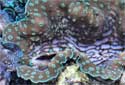
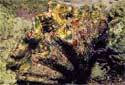
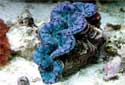
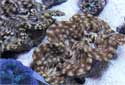
The pictures of clams shown here gives a quick look at the types of tridacna (Giant Clams). For information on each of the types of clams and to see more pictures, be sure to visit each individual clam page.
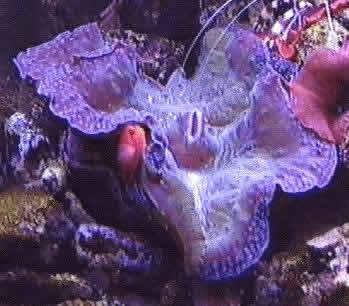
Giant Clam
Tridacna gigas
The Giant Clam is usually blue, golden brown, yellow or green. They have lots of iridescent spots all over the mantle, but more concentrated on the edges. Grows to a maximum length of 1.5 meters (4 ft.). Very large.
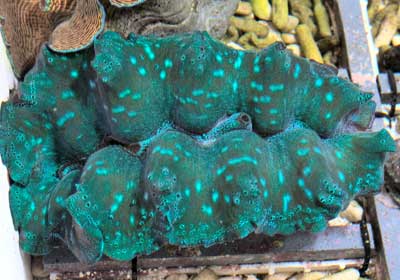
Burrowing or Crocus Clam
Crocea Clam
Probably the most colorful clam, the crocea burrows into the reef making it hard to remove. It comes in a variety of colors, (blue, purple, green, brown, gold) with different colored iridescent spots or lines. This clam needs very intense light. Grows to a maximum length of 22 cm (9 inches).
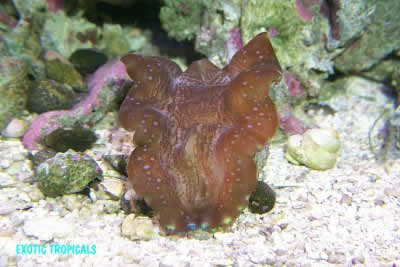
Derasa – Tridacna derasa
Photo © Animal-World
Generally has striped or wavy line pattern. Colors include brown, light green, orange, yellow, blue, and white. It occurs naturally at greater depths than Crocea, 4-10 meters (12 to 33 ft.) and requires less light. Grows to a maximum length of 50 cm (20 inches).
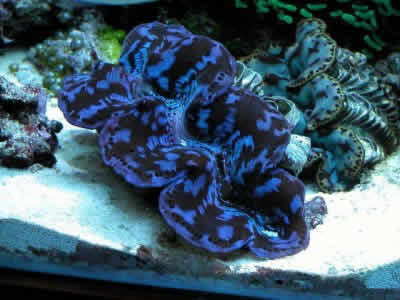
Tridacna maxima
Photo: Keith Berkelhamer
Tridacna Maxima looks a lot like Crocea. It comes in a variety of colors, (blue, purple, green, brown, gold) with different colored iridescent spots or lines. The biggest difference is the shell. T. maxima has a more elongated shell, usually 3 times longer than it is wide. The scutes on the outside of the shell are more pronouned and cover more of the shell in T. maxima than in T. crocea. This clam needs intense light. It will grow to a maximum length of 35 cm (14 inches).
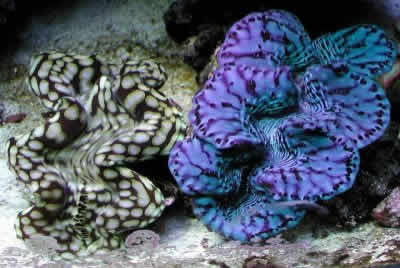
Tridacna squamosa(left)
Tridacna maxima (right)
Photo: Keith Berkelhamer
Tridacna squamosa’s are most commonly found with a brown mantle with many golden brown or yellow wavy lines. The mantle can be high in color with green and blue spotted varieties.
T. squamosa’s reach a maximum length of 16 inches (40 cm).
Featured Image Credit: Rob Atherton, Shutterstock